“The other aspect of narrative selfhood is correlative: I am not only accountable, I am one who can always ask others for an account, who can put others to the question. I am part of their story, as they are part of mine. The narrative of any one life is part of an interlocking set of narratives.”
I find this particular section to be agreeable because we’ve also seen this being done in history documentaries. Often it’s not the direct words of the historical figure, but someone who retells the deeds of what they’ve done. Take Martin Luther King for example, in all of the history books he’s not the one telling his story, but eye witnesses of the time will contribute to the books by telling people what they say and have those recollections influence the books.
The other example is like the one I said in class. At that session I said that I was a huge influencer of my friends’ life because of my actions. That action being where at one time I was looking to expand my group friend chat with some of my other friends. I had my closest friend, Oscar to join us. But by deciding upon that I ultimately affected his narrative because by joining this chat he had gained a significant other within the following years. Had I not done this, I’d doubt that our narrative or account for one another would be less intertwining.
Though let’s change perspectives as I can account for his life he can do that same and account for aspects of my life. I definitely come off as the unapproachable and silent type whenever I’m idly by, but Oscar can account for the type of person I really am. He knows that I’m more talkative and more goofy amongst closer friends. Although he’s one of the few people to know I used to act as a sort of counselor for people at the time. He’s seen me do it at group chats or to random strangers online. Where I would generally hear a person out, have them vent some of their problems out and I would do my best to make them feel better. Whether it was about someone recently mourning a loss or talking someone out of suicide, he’s seen do it and can account or it.
So relating back to the quote, it’s unquestionable that everyone’s story or narrative always gets interlocked by someone or something at some point or another.
I find Leonard’s statement of us requiring to have some sort of mirror to remind us of ourselves to be quite agreeable. Our memories are good enough on their own, but they’re definitely not perfect. Some of us have very dormant memories that can’t be called forth from our will. However something tangible like a photo can trigger that dormant memory straight away. For example, in front of my desk I have a photo hanging in front of me on my wall, it’s a photo of me in the 4th grade smiling and holding a tree sapling. Looking at this photo it instantly triggered my memory, it reminded me of what I wanted to know at the time. At the time there was a lesson for the students to respect nature, so each of the students were given a sapling and wrote their names on the pot. So when my photo was taken I wondered to myself, “what will this sapling look like when I grow up?” And to this day I wonder what happened to it, whether it died or is blossoming somewhere as a tree. But had I not seen this photo on right now, that memory would’ve likely stayed somewhere in the back of my mind, never to be called forth.
Although Leonard’s case is rather different since he requires these mirrors at all times to remind himself of his objective, ultimately his mirrors are ultimately faulty. There is a clear difference between the way he uses things as mirrors and how a normal person uses these mirrors and that’s context or dormant memory if you will. Look back to my previous mention of my photo, I know the context/history behind it because I partially remember that event taking place. But that isn’t how Leonard’s mirrors work, his tattoos are just text on his body and his photos are just that but with some writing. He doesn’t know the context of why he got the tattoos or the full story of each of his summarized photos. To put this in a better perspective, let’s say I write on my photo saying, “held sapling because of a lesson” and I erased my memory then looked at the photo once more. The only thing that I would know about that photo is what I’ve written and nothing else. Not how we wrote our names on the pot nor what I wondered at the time, only my written text. And that’s the thing with Leonard he becomes some sort of person who only acts on a whim based on his photos/tattoos. Without that context he gets himself into trouble, like how he enters the bar with the car and suit of the person he just killed.
Without my mirrors, I feel like I wouldn’t be any different. I feel like I’d miss out on some old memories, but I would still be the same type of person.
Regarding how the mirror system’s relation to Hume’s theory. These are fundamentally the same, as Hume writes, “…I may venture to affirm of the rest of mankind, that they are nothing but a bundle or collection of different perceptions, which succeed each other with an inconceivable rapidity, and are in a perpetual flux and movement.” Each photo or tattoo that Leonard writes are still his perceptions despite having no memory of the photo/tattoo, yet each of those photos/tattoos successively and indefinitely move him to the next photo/tattoo. Which is not much different as how our memories continually influence us and make us more memories based on that memory.
Hi, my full name is Martin Deocate Nguyen. If you’re rather attentive you’d notice that my blog’s name is just my first name in reverse. Story about that is just that I remember seeing an old Facebook post years ago saying your new name is your name in reverse. I found that Nitram had a nice ring to it, so I often use it at my online alias nowadays. And it’s funny too, cause sometimes i’m just minding my own business on online games and people will message me and say “Hi Martin” acting as they know me just because they deducted my names was just in reverse, those were fun times.
Anyhow, when it comes to upbringing there’s not much to say really. I grew up from 1 to 5 in Sacramento then we moved to Elk Grove and still live here up to now. School was definitely an interesting ride up until I had to move to a different track/scheduling to accommodate for my family’s vacation trips. When I switched to this track I was often picked on for some reason from 4th grade till 6th grade. It was annoying to have to deal with it, but I still made some good friends from that track. So I’m also grateful for having that switch too.
As for gifts, I guess it can be said that I always try to help my friends by acting as a sort of counselor for them. I’d let them vent their problems onto me and I would try to help them feel better and what not. But as for academic gifts, I honestly can’t say anything for that unless procrastination is counted?
Struggles would definitely be something like living under my sister’s shadow. She always had good grades and so I would be expected to do the same. But for me it was difficult because I was never an academic type of person, I never had any true passions to make me want to pursue a greater knowledge and anything that I learned just went from one ear to another. So in turn I got grounded for bad grades and often went on time outs by a wall and was restricted from games and TV. Which in turn further degraded my will to learn to the point of “what’s the point of trying?”
Breakthrough was right about when I reached 8th grade something mentally just clicked in my head and I was trying a bit more to not fail or get Ds in classes. Some lessons and concepts made a little more sense and stayed in my head more too.
Video games are an art form like no other. Because it takes many other forms of art such as visual art, story telling, sound design, animation and merges them into one spatial plane. These aspects are the basis of any game, but there is one more thing that is required for any game and that’s you, the player. What makes games so great is that you have direct interactability with the game world as you’re playing it. Also meaning that you have the utmost immersion compared to any other art-form.
And of course I do have a pristine example for this topic, of which said example is no other than a childhood classic, Maplestory. For those who are unfamiliar with this game, Maplestory is a game where you’re allowed to make your own character and venture out into the Maple World. As you go on about your journey within this world you will be met with vast amounts of areas to explore, music that is unique to each corresponding area, take quests from NPCs that will provide you some story or lore to the area you’re in, and you’ll also be using your skills to defeat any foe that stands in your way, all in order for you to level up and make your character grow stronger.
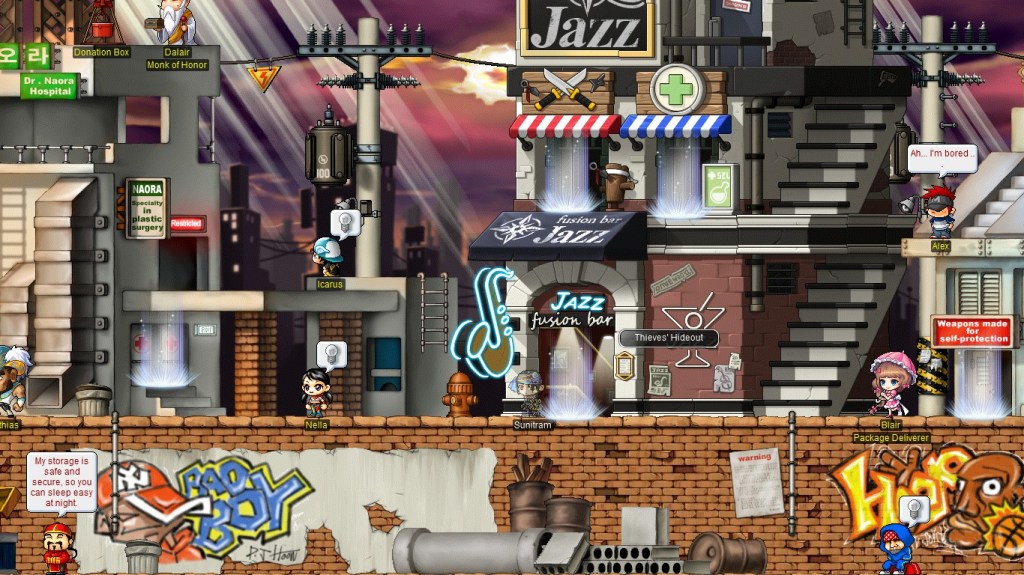
So how does this game relate to art and Tolstoy’s three requirements of infectiousness? Well to answer that, we have to go back to the afore mentioned aspects of a game. Take this image for example.
Looking at this image you can see the the clear intent of this map is to follow dangerous ghetto theme where crimes and thievery occur often. This is the drawn aspect that infects the player with some sense of the atmosphere in the area that they’re in. Here’s another example
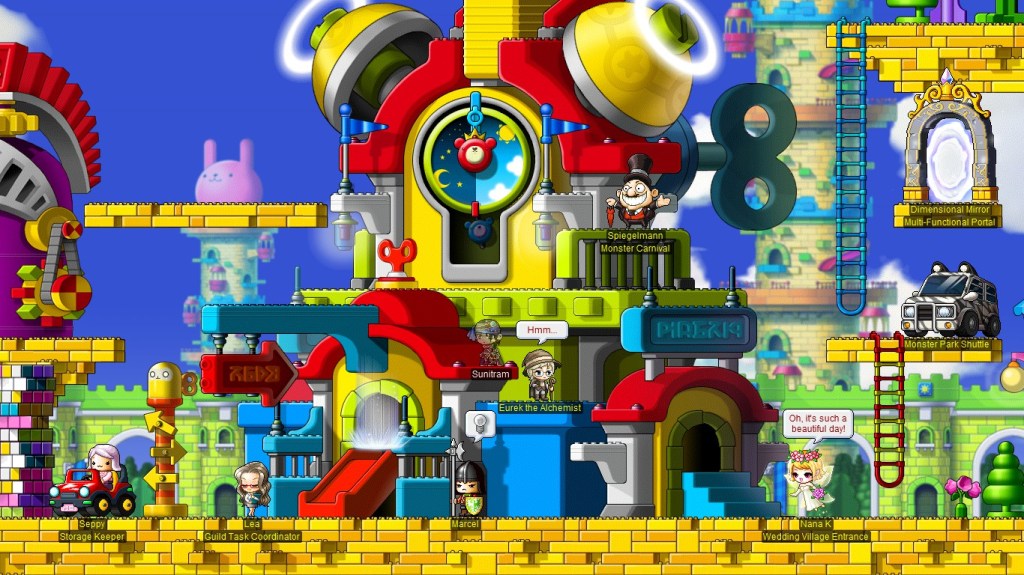
In this map we have such a surreal view a toy wonderland theme. A town completely made up of building block pieces with a mix of other children for toys and even some of the NPCs are figure toys as well. Again this ties to the visual aspect and shows its visual creativity to immerse the player in a different world/atmosphere.
Moving on to the second aspect, is the story telling. The below images is just a simple quest line.
I know that this dialogue isn’t much. But I enjoy the aspect of your character being a part of the story and sometimes has meaningful life lessons for the player to interpret. The story of any game has to be compelling enough to further add the feel of the atmosphere to the player.
Onto the third aspect, sound design. You may have noticed that the text under each image is a hyperlink. Each link will send you to YouTube to enjoy the music of the corresponding area. What I would like to point out is that if you listen to the music and look at the provided images, you’ll likely find that the music fits with the theme of the area and adds more immersion to the atmosphere as you play.
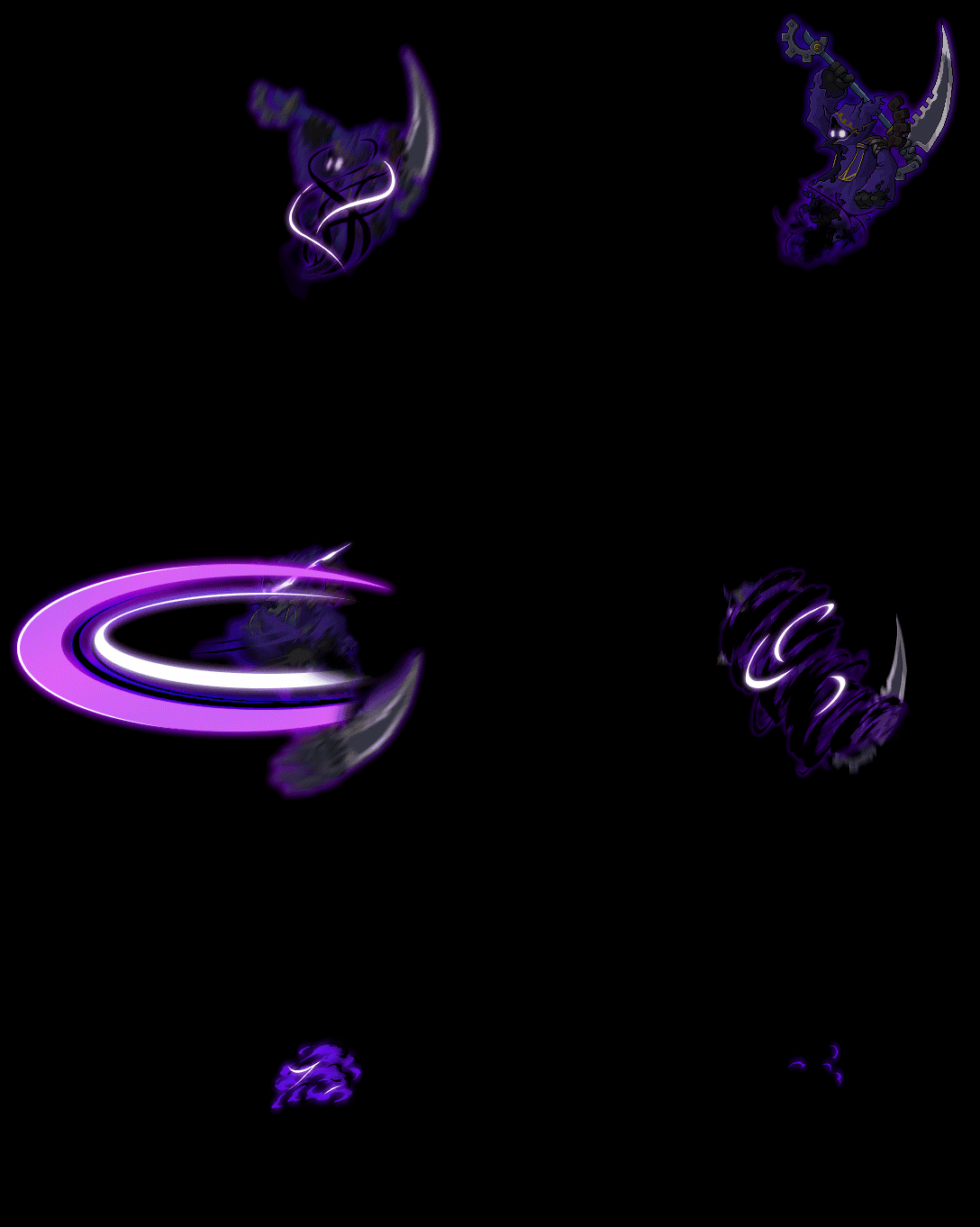
Lastly, merging the aspects of animation and interactability into one. As mentioned before, your character travels and defeats monsters along the way. The attacking skills are generally well animated and add to the feel that your character is strong when you’re casting skills. For example,
Sweeping StaffGrim Contract Attack
Though it doesn’t seem to be much on paper, but when put through an actual session the interactability you have as a player is extremely immersive. Knowing when to attack, observing the bosses, and maneuvering through obstacles to avoid death.
To put it back together, all of these aspects are what causes video games to be art. The visual appeal, auditory atmosphere, beautiful animations, and the technical skill of the player. It all infects the player with the sense/atmosphere of another world that the developer of the game had in mind.
Following Tolstoy’s requirements of art, video games easily fit all three of them. The individuality, the clarity of emitted emotion, and sincerity is present in many of today’s indie and triple A games. It’s all thanks to the fact that video games are culminations of already existing art forms with the key element of “interactability” added to the mix.
Just as Tolstoy writes, “The absence of any one of these conditions excludes a work form the category of art and relegates it to that of art’s counterfeits. If the work does not transmit the artist’s peculiarity of feeling and is therefore not individual, if it is unintelligibly expressed, or if it has not proceeded from the author’s inner need for expression – it is not a work of art. If all these conditions are present, even in the smallest degree, then the work, even if a weak one, is yet a work of art.”
Same as to what Tolstoy writes, if it doesn’t follow the three requirements, then it is not true art. The same can be said with games, if it misses any one aspect, then it is not a true game. A game with no sound will be bland. A game with no story will be boring, and so on.
Having power is the ability of knowing factual/proven knowledge.
Such knowledge is better for society.
Knowledge with no sound basis is harmful to society.
It is dutiful for society to filter out all unproven knowledge.
C. Therefore all unapproved knowledge is not beneficial to society and must be weeded out for the toxin it is.
I understand Clifford’s main argument is to instill the readers with the idea that all beliefs without sufficient evidence is a sin and harms the integrity of man. But there are two reasons why I find this to be a fallacy. The first reason is that his argument is counter intuitive because he writes, “No man holding a strong belief on one side of a question, or even wishing to hold a belief on one side, can investigate it with such fairness and completeness as if he were really in doubt and unbiased; so that the existence of a belief not founded on fair inquiry unfits a man for the performance of this necessary duty” (Pg. 3).
This statement creates a problem because by following this logic, he simply admits that his own belief is flawed and unaccredited. Then according to his argument, his own argument should be disregarded as there is no sufficient evidence to support his claim. Especially when it involves his idea claiming its “man’s duty” to cleanse unproven ideas.
The second reasoning is that there are good actions being done even if the belief if yet to be proven. Take religion for example, (Disclaimer: I’m not trying to offend anyone’s religion) the basis of most religions follow a god or a important person, but the stories of those entities are generally farfetched and have yet to be proven, such as Jesus’ revival or the Buddha’s indefinite time sitting under a tree for the answers of life. Despite people believing in something that is not proven, it still brings them good to them and to the society. Is the phrase “Honor your father and mother, and, You shall love your neighbor as yourself” automatically bad because it stems from an unproven religion?
Following Clifford’s logic once more, this would mean all the wise teachings from religion is also not good because the religion itself is unproven.
Tolstoy’s standard of art is to explain that it’s not as simple as it seems. He defines this standard as a work that evokes the same feeling the author had when creating his work. Paragraph 7 provides a good example of this, saying that when a boy encounters a frightful wolf and lives to retell his tale, he should be able to evoke a sense of fear, imagery, and surrounding to his audience. And also that this retelling shouldn’t be altered in anyway for dramatic reasons, it should only be told in the same way as how the author had perceived it.
Yes, this is a good way to evaluate art. Because it’s based on capturing the feeling and inspiring other to have the same feelings as the artist. It follows a checklist of having a sense of individuality, capturing and emitting the emotion, and most importantly the sincerity of the artist. In which sincerity is the most important because the author is staying true to his experience and work. If he is controlled by greed or fame, his work will be diluted in authenticity due to him appeasing the crowd’s demand or exaggerating parts of his work. Therefore reducing his work’s ability to evoke a sense of passion to his viewers. But by staying true to your work, it will have the utmost effect upon the viewers, as is stated in paragraph 33.
An example of this sincerity can be seen in works like games. Such as games like Half-Life 1 and Black Mesa. HL1 is a classic game that most PC gamers know about. There where Black Mesa steps in, it’s a HL1 fan made remake of it. The sincerity of this game is that it does nothing to deviate from the original story line, it’s simply a 1 to 1 copy but with more modern graphics. There’s no doubting the sincerity of this, as the reviews are full of positive feedback if you look up the game on Steam.
eXistenZ relates to Plato’s level concept of reality because the constant shift in realities in between the virtual world and real world.
At the 1st level of reality, ideas and concept, the game is meant to be an alternate reality for users to live out another life as a different character archetype rather than their real life counter part. But this idea of having more than one reality is only good on paper.
In the 2nd level, the physical world, while the virtual reality is effective at simulating reality, there’s still consistent flaws with it seen throughout the movie. One of them is the conversation loops that Pikul and Allegra have with the NPCs, where if they say something out line from their game personality, the conversation with the NPC won’t progress. This exemplifies Plato’s concept of the physical world because it tries to bring idea/concepts to the real world, but the overall conversion from concept to physical is partly flawed.
At the 3rd level, Art, where art only shows a certain view of the painted subject but the viewers and artists still don’t know full practical use of the subject. This can be applied to eXistenZ because a virtual reality is an art form. The game already explains its purpose, but since the game is only viewed at as the same perception of reality. This art form negatively affects its users to the point that they cannot discern between the virtual and the real. Which can be seen at the end of the movie. Again, this exemplifies the 3rd level because of Plato’s disdain of art, saying you cannot gain true knowledge from it and ultimately you’ve gained false knowledge.
When it comes to movies we are often deceived by clichés. As an example, scene where a man is walking away from an explosion completely unscathed. In reality, the man’s back would be burnt quite severely.
As for media, we’re heavily deceived/influenced based on the bias and or the author’s self-authenticized word. For example, I remember reading a post on Quora talking about the lies/negativity of social media. In the post it discussed how a single person claimed that the picture they posted was an image of an Iranian boy who was shot by a soldier after peaceful protest. This image had gained traction across the internet as a legitimate photo and people created a ruckus over it demanding for justice. Fortunately, it wasn’t real, upon further inspection it was revealed to be an old movie that no one knew about due to lack of translation. All of this transpired just because someone wanted internet fame. Rather than spreading real news, they took advantage of the unknown and bent the movie into their lying will.
So yes, due to certain medias there are times we confuse fiction with reality. But I do believe that the physical world we live in is real. Because it’s how you perceive the world that you can ascertain what reality it is. Reality for one person can be “eat, work, sleep, repeat” for another it can be “relax, cherish friends and family, and live life to the fullest” and etc. It’s hard to make sense of what I’m trying to say, but it can be thought of as this. The physical world is our sandbox and what we make out of the sand is our reality. One can make a castle and the other could make a city building.
As for how this relates back to the Allegory of the Cave, considering that the cavemen only see shadows as their only source of information is not much different in my examples regarding movies and that Quora post. To the general population, the depictions of that movie explosion or false news is the shadows we see. And the people who look more into the technicalities of things is the cave man who exited the cave and found true knowledge. But no matter how much that person tries to spread the truth, there would be little effect to change the masses mind about the misinformation.










 Nitram’s Blog